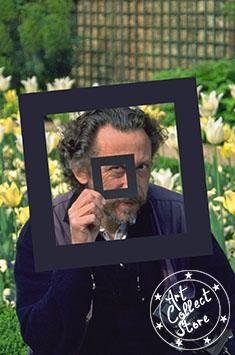
Jean-Baptiste Leroux

Some childhoods open their eyes wider than others. That of Jean-Baptiste Leroux, born in 1949 in Touraine, was shaped by the reflections on the Loire, the rustle of leaves, and the misty mornings over French formal gardens. It is there, in this Loire Valley steeped in heritage, that his sensitivity to light and the harmony of forms took root. From adolescence onward, he captured the world as a landscape to be revealed: gardens, tree silhouettes, architectural remnants — each subject becoming a scene to elevate.

A photographer of nature in its grandeur, Jean-Baptiste Leroux moved to Paris, where his eye was refined through contact with the great masters. He successively directed the Nikon Gallery in Saint-Germain-des-Prés and the Canon Gallery in Beaubourg. It was the late 1970s, and within this artistic effervescence, he crossed paths with emblematic figures such as Robert Doisneau, Jacques-Henri Lartigue, and Lucien Clergue. This companionship of kindred spirits confirmed his desire to photograph silent beauty.

Explore the artworks

A selection of Available Works

Explore the Gallery

The turning point came in 1985. At the Domaine de Courances, his encounter with Madame de Ganay led to his first exhibition of photographs dedicated to historic gardens. It marked the beginning of a profound vocation — that of revealing, through the lens, the poetry of places shaped by human hands yet offered to the sky. Versailles, Vaux-le-Vicomte, the gardens of Sanssouci in Germany, Caserta in Italy, La Granja in Spain, the royal estates of Morocco… The list of sites he has exalted is impressive, yet always guided by the same approach: capturing the instant when light transforms the ordinary into a miracle.

For Jean-Baptiste Leroux does not photograph gardens — he listens to them. He waits, often for long hours, for dawn or dusk to reveal a texture, a reflection, a hidden depth. In his images, a pond becomes a mirror of eternity, a shadow rises like sculpture. At Versailles, the Dragon Fountain or the Grove of Enceladus become near dreams. Elsewhere, two albino peacocks descending with grace evoke brides from a baroque fable. One must know how to look — and to be surprised. In his work, nature always has the last word.

Winner of the Redouté Prize for the best book on garden art and the Eugène Carrière Prize from the Académie Française in 2000 for *Jardins à la française*, Jean-Baptiste Leroux is also the author of numerous publications and the curator of several prestigious exhibitions, including *Jardins extraordinaires* displayed on the gates of the Jardin du Luxembourg in 2017. His talent is regularly sought by major houses — from Dior Parfums to Peugeot, Essilor, and Mercedes-Benz France — for image campaigns and luxury editions.

His body of work bears witness to a silent yet constant dialogue with Mother Nature. It reveals a unique way of photographing the passing of time, the shifting elements, and the whispering stones. In 2014, a floral tribute crowned his journey: the *Jean-Baptiste Leroux* rose — delicately scented and remarkably vigorous. Like his images, it endures through time and blooms with grace.